Enter your email to view this content
The Second Half of IGP Sampling Has Begun
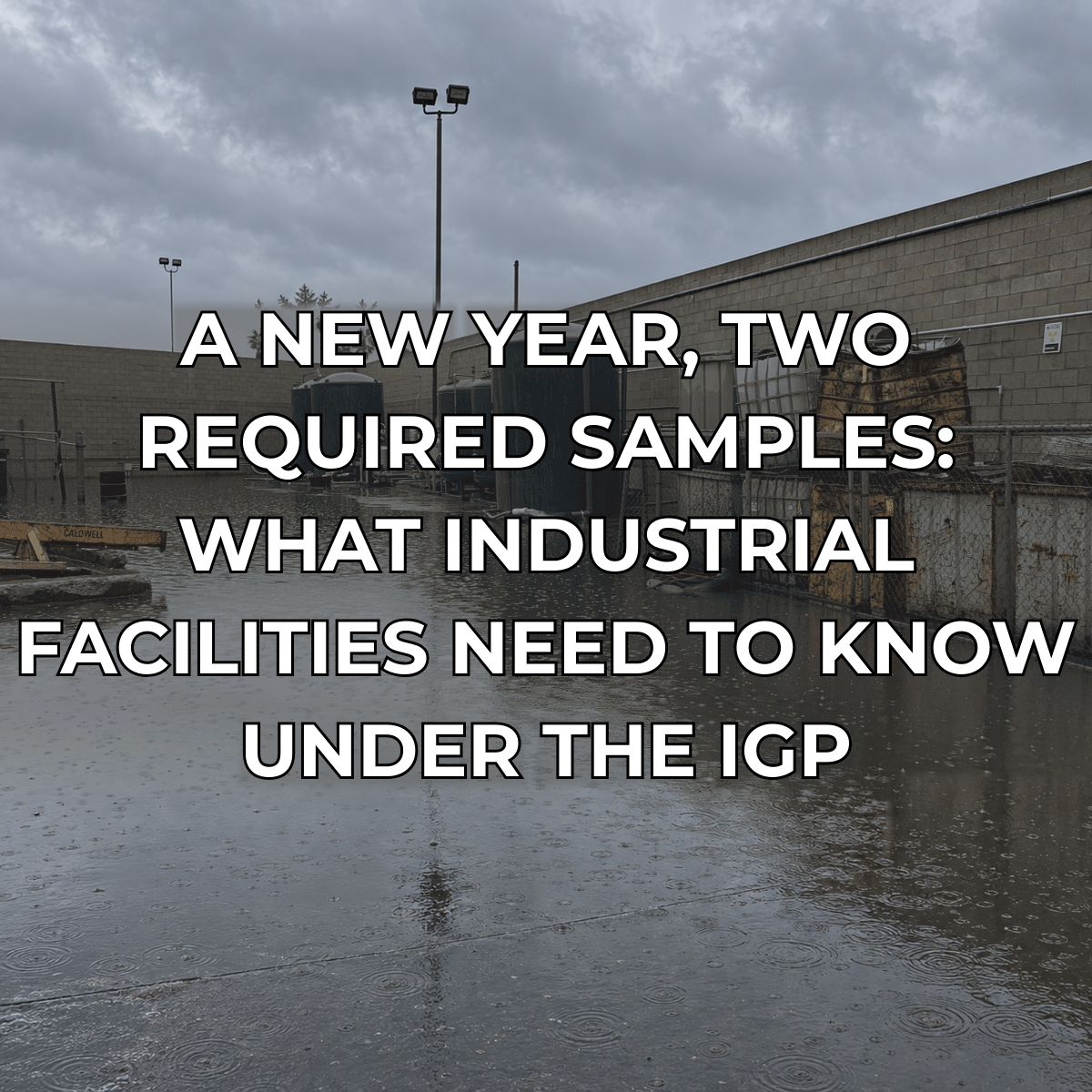
For California industrial facilities covered under the Industrial General Permit (IGP), the new year marks more than just a calendar change; it signals the start of the second half of the reporting year and a renewed focus on stormwater sampling requirements.
Under the IGP, facilities must collect four qualifying stormwater samples per reporting year (July through June). Two samples are required during the first half of the reporting year, and two additional samples must be collected during the second half.
Facilities that have already collected their first two samples now need to ensure they successfully capture the remaining two before the reporting year closes on June 30.
Understanding the IGP Sampling Structure
The IGP reporting year runs from July 1 through June 30, not January through December. Sampling requirements are structured to ensure stormwater performance is evaluated across the entire wet season.
To remain compliant, facilities must:
- Collect a minimum of four qualifying stormwater discharge samples per reporting year
- Capture two samples between July and December
- Capture two samples between January and June
- Ensure samples meet all qualifying storm event criteria
Failing to collect the required number of samples in either half of the reporting year can result in compliance issues, even if earlier sampling was successful.
Why the January–June Window Deserves Extra Attention
The second half of the reporting year often presents unique challenges. Storm patterns can become less predictable, and the number of qualifying storm events may decrease as the wet season tapers off.
Facilities entering January without a plan for the remaining two samples may face:
- Fewer qualifying storm opportunities
- Increased pressure to sample during marginal storm events
- Limited time to respond if results show elevated pollutant levels
- Less flexibility to adjust BMPs or treatment systems before the reporting year ends
Planning early in the second half allows facilities to avoid last-minute sampling and maintain defensible compliance records.
Using Early Second-Half Samples as a Compliance Checkpoint
The first sample collected between January and June can serve as a critical checkpoint for the remainder of the reporting year.
Early second-half sampling provides insight into:
- Whether BMPs continue to perform as expected
- How pollutant concentrations are trending as conditions change
- Whether additional controls or adjustments may be needed before the final required sample
If exceedances or near-benchmark results appear, early identification creates time to evaluate corrective actions and improve performance before the reporting year concludes.
Preparing BMPs and Treatment Systems for Second-Half Sampling
As facilities transition into the second half of the reporting year, system readiness becomes increasingly important.
Preparation may include:
- Inspecting and maintaining BMPs after early-season storms
- Removing accumulated sediment and debris
- Verifying treatment systems are operating at appropriate flow rates
- Confirming sampling locations remain accessible and representative
Facilities relying on engineered treatment systems benefit from confirming performance capacity ahead of remaining storm events, particularly as runoff characteristics change later in the season.
Avoiding End-of-Year Sampling Pressure
One of the most common compliance challenges occurs when facilities attempt to capture both remaining samples late in the season. This approach leaves little room for error if storms do not meet qualifying criteria or operational constraints interfere with sampling.
By prioritizing at least one sample early in the January–June window, facilities preserve flexibility and reduce risk as June 30 approaches.
A Strong Finish Starts with a Clear Plan
The second half of the IGP reporting year is not the time to rely on luck. Facilities that approach January with a clear understanding of sampling requirements, storm timing, and system readiness are far better positioned to meet permit obligations without unnecessary stress.
Whether your site relies on foundational BMPs, advanced stormwater treatment systems, or a combination of both, proactive planning during the second half of the reporting year helps ensure compliance through June 30 and beyond.