Enter your email to view this content
The 2026 Super El Niño is underway.
This year's event crossed the formal super El Niño threshold in August 2026, and NOAA's Climate Prediction Center now projects a 95% chance of a very strong event peaking October through December, with sea surface temperature anomalies forecast to reach +2.66°C, which is a level that would exceed every recorded El Niño since 1950. This will have real consequences for precipitation across North America, especially along the West Coast. How can operators prepare for unusual weather events and stay in compliance with stormwater regulations?
What a Super El Niño Actually Does to West Coast Precipitation
“The Pacific Ocean’s El Niño-Southern Oscillation (ENSO) is arguably the most influential climate driver on Earth. Its cycles of warm and cool waters in the central and eastern equatorial Pacific alter where ocean heat is released into the atmosphere, influencing atmospheric circulation, temperatures, precipitation and other weather events that affect agriculture, wildfires and marine fisheries around the globe.” - NOAA
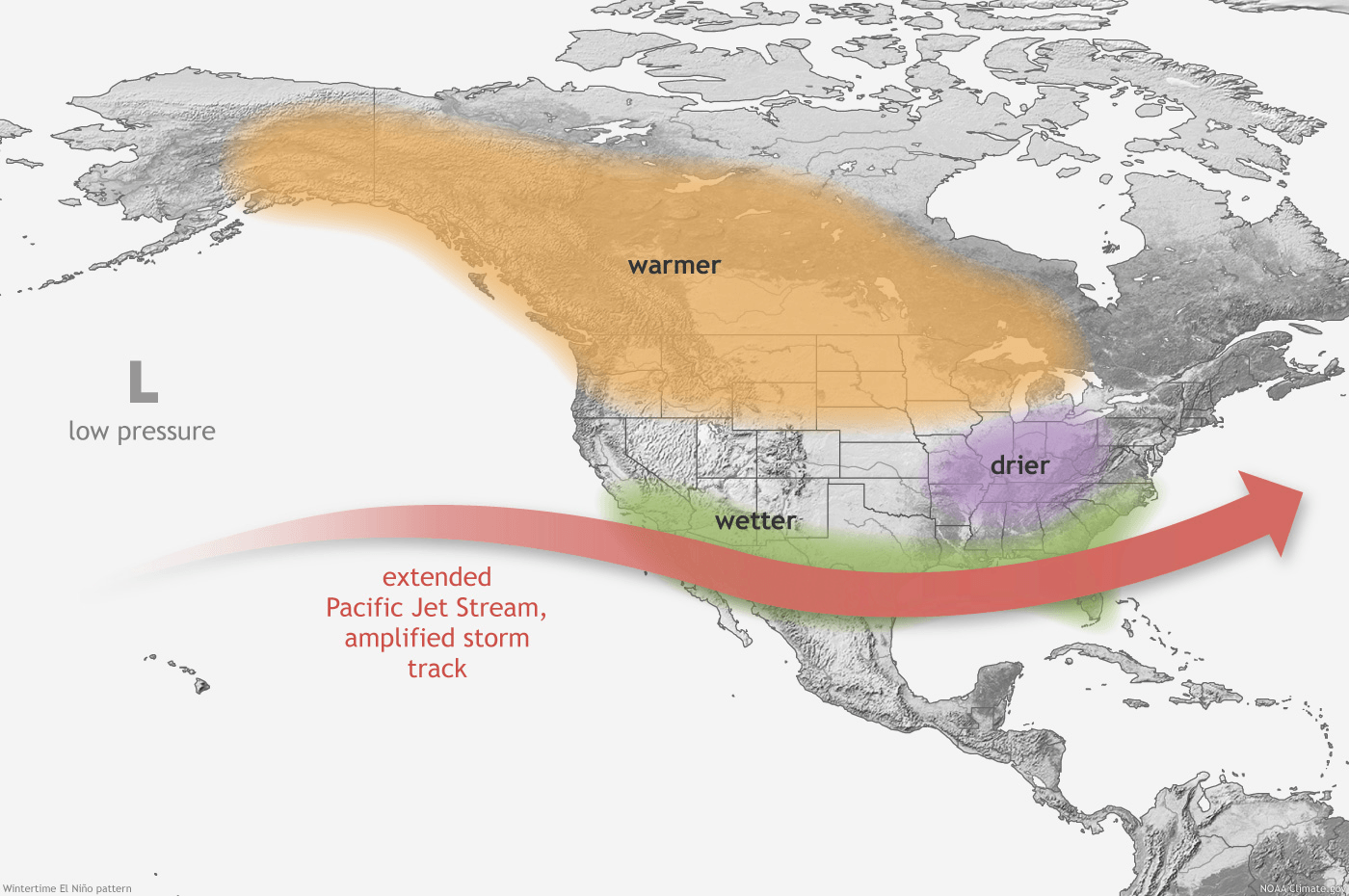
El Niño alters both the polar and Pacific jet streams. During a strong event, the Pacific jet stream strengthens and stretches eastward, driving wetter conditions across the western and southwestern United States. Long-range forecast models predict this El Niño will shift the jet stream southward, producing a wetter-than-average pattern for California and the broader West Coast through the fall and into winter.
For Southern California, a marine heat wave off the coast could combine with the El Niño signal to produce more thunderstorm activity than is typical for the region. Moderate-to-strong El Niño events produce widespread wet anomalies across the southern tier, with the strongest precipitation signals concentrated along the California coast.
Translation: more rain, faster. And more rain faster is precisely when stormwater systems and the compliance obligations tied to them face their greatest test.
History bears this out. During the powerful 1997–98 El Niño, California experienced widespread flooding and major property damage. The Los Angeles River has historically gone from a shallow stream to a raging torrent within hours during El Niño-driven storm events. These conditions expose every gap in a site's stormwater controls.
The Compliance Framework Doesn't Pause for Weather
The National Pollutant Discharge Elimination System (NPDES) stormwater program, administered by the EPA and delegated to most states, requires operators of construction activities and industrial sites to obtain permit coverage before discharging stormwater, regardless of the weather. Any construction activity disturbing one or more acres of land requires a Clean Water Act permit. Sites smaller than one acre aren't off the hook either, if they're part of a larger common plan of development.
The minimum federal requirements dictate that operators must design, install, and maintain effective erosion and sediment controls; stabilize disturbed areas when work pauses for more than 14 days; and prohibit unmanaged dewatering discharges. These obligations don't carry a weather exemption, and regulators will not issue compliance waivers because El Niño is in the forecast.
In states like Washington and California, two of the West Coast jurisdictions most directly in the path of elevated precipitation, construction stormwater general permits (CSGP) require operators to develop stormwater pollution prevention plans (SWPPPs) and implement best management practices (BMPs) before ground is broken. Those plans must account for actual site conditions during rainfall events.
More Rain = Higher Compliance Risk, Not Lower
When people hear "El Niño is coming", the instinct is sometimes to think: well, at least the site will get rinsed off. That instinct is exactly backward.
Heavy, sustained rainfall overwhelms stormwater infrastructure and poorly planned BMPs. Coastal flooding can submerge outfalls, drive backflow into drainage systems, and prolong inundation events. Debris clogs storm drains and pipes. On construction sites, saturated soil is far more susceptible to erosion, and eroded sediment carried off-site is the primary pollutant of concern that NPDES construction permits are designed to prevent. The EPA estimates that construction sites without adequate controls can lose 20 to 150 tons of soil per acre annually to stormwater runoff.
Add to this the compounding effect of El Niño on coastal areas: elevated sea levels, king tides, and storm surge can all converge simultaneously. In prior El Niño events, observed tides at Southern California NOAA stations reached levels higher than any previously recorded, even during storms. When that coincides with a precipitation event on an unprepared site, the consequences are physical and legal.
Regulators are more active during significant storm events, not less. Inspections increase, and discharge violations are more visible and easier to document. Penalties under Clean Water Act enforcement are substantial, and they are not waived because the storm is unusually intense. In fact, regulators treat the failure to prepare for foreseeable weather events as a fundamental compliance failure.
The PNW Exception: Drought, Dry Season, and the First-Flush Problem
Not every part of the West Coast is bracing for more rain. The Pacific Northwest faces a fundamentally different, and in some ways more insidious, compliance challenge under the El Niño pattern.
For the Pacific Northwest, El Niño produces a hotter and drier pattern through the summer, with severe drought expanding across more of the region into the northern Rockies as the event strengthens into fall and early winter. This isn't a new development. Washington has declared statewide drought emergencies for four consecutive years, and the El Niño pattern tends to bring earlier snowmelt, reduced snowpack, and drier soils; a cascading effect that compounds existing drought conditions. Oregon is tracking similarly.
So what does prolonged drought mean for stormwater compliance? For operators who aren’t paying attention, there’s a dangerous risk of accumulating contaminants.
The First-Flush Effect: Dry Periods Build Pollutant Loads
When a site goes weeks or months without significant rainfall, pollutants accumulate on exposed surfaces: sediment on disturbed ground, oils and metals on paved areas, myriad contaminants on industrial sites. When rain finally arrives, even a moderate storm mobilizes that entire accumulated load at once. This is the first-flush effect, and it is directly relevant to NPDES compliance.
Research on stormwater discharges in Mediterranean-climate regions like California found that pollutant concentrations in the early part of the wet season ranged from 1.2 to 20 times higher than at the end of the season. The same principle applies to the PNW following an extended dry period. First flush describes the concentration of pollutants that builds up during dry periods and is then carried by runoff during the initial part of a storm. The longer the dry period, the greater the accumulated load, and the more concentrated the discharge when the first storm hits.
For a construction site that has sat relatively undisturbed through a hot, dry summer, the first fall rain event is a pollutant flush. And that hits receiving waters like streams, wetlands, and MS4 inlets at its most concentrated.
Less Dilution in Receiving Waters
The problem compounds downstream. Extended drought reduces baseflow in streams and rivers. Stormwater runoff carries pollutants including sediment, oils, herbicides, nutrients, bacteria, and metals that drain directly into local streams, lakes, and bays. Under normal conditions, streamflow dilutes those pollutants as they enter receiving waters. Under drought conditions, there's less water in those systems to do the diluting. The result is higher in-stream pollutant concentrations from the same discharge event, which means greater potential for water quality violations and greater harm to aquatic life.
This is a meaningful distinction for NPDES compliance. Permit conditions tied to water quality standards don't adjust for drought. A discharge that would be within acceptable limits under normal flow conditions may exceed those limits when the receiving water is running at a fraction of its typical volume. The regulatory standard stays fixed while the environmental risk goes up.
Drought Conditions Don't Suspend Inspection Requirements
A common misconception is that NPDES inspection obligations are tied to precipitation events, so a dry summer means fewer required inspections. This is only partially true. While many permits require post-storm inspections above a threshold rainfall depth, routine inspections are required on a calendar basis regardless of weather. A site that goes months without rain still needs to be inspected. BMPs still need to be documented as functional. SWPPPs still need to be current.
More importantly, a dry summer is exactly when site operators should be reinforcing controls in anticipation of the wet season, not assuming that the absence of rain means the absence of risk. When fall storms arrive in the PNW, they can arrive suddenly and with significant volume. A site that deferred BMP maintenance through the dry season will be tested immediately and without warning.
What Proactive Compliance Looks Like in a Super El Niño Year
If anything, the Super El Niño forecast is a prompt to do more, not less. That means:
Review and update your SWPPP now. Stormwater pollution prevention plans should be site-specific and current. A plan written for average precipitation conditions may not hold up under El Niño volumes. Walk the site with this forecast in mind and identify vulnerabilities (or hire an expert to do it for you).
Inspect and reinforce BMPs before storm season. Silt fences, sediment basins, inlet protections, stabilized construction entrances... all of these degrade over time and require maintenance. Heavy rain events stress them immediately. Make sure they're inspected and repaired before the first significant storm, not after.
Increase inspection frequency. NPDES permits typically require inspections at defined intervals and after qualifying storm events. In a high-precipitation season, consider exceeding the minimum frequency. Documentation of good-faith inspection and maintenance efforts matters if a violation occurs.
Coordinate with downstream stakeholders. Municipal storm sewer systems (MS4s) in West Coast jurisdictions are subject to their own permit conditions. Sites discharging to MS4s should communicate with municipal contacts about anticipated volumes and confirm that connections are in compliance.
PNW operators: treat the end of dry season as a compliance deadline. The first significant fall storm will mobilize everything that built up over a dry summer. BMP inspections, SWPPP reviews, and sediment control reinforcements should be completed before the first rain event rather than being triggered by it.
Don't assume prior compliance carries through a major event. A site that has been in compliance through a dry period has not been tested.
The Bottom Line
The 2026 Super El Niño is currently one of the strongest on record, and the West Coast is in the direct path of its precipitation impacts. It is a reason to treat stormwater obligations with greater urgency than you have in recent years.
Stormwater compliance is, at its core, about managing what happens when it rains. A super El Niño year is when it rains harder, more often, and with less predictability than normal. The regulatory framework was built for exactly these conditions, and regulators expect operators to be prepared for them.
For site-specific guidance on stormwater compliance, reach out to our team. To review the latest regulations and benchmarks, consult your state-specific regulatory agency.